Interactive and PDF Learning Disability (LD) Adapted Psychotherapy File
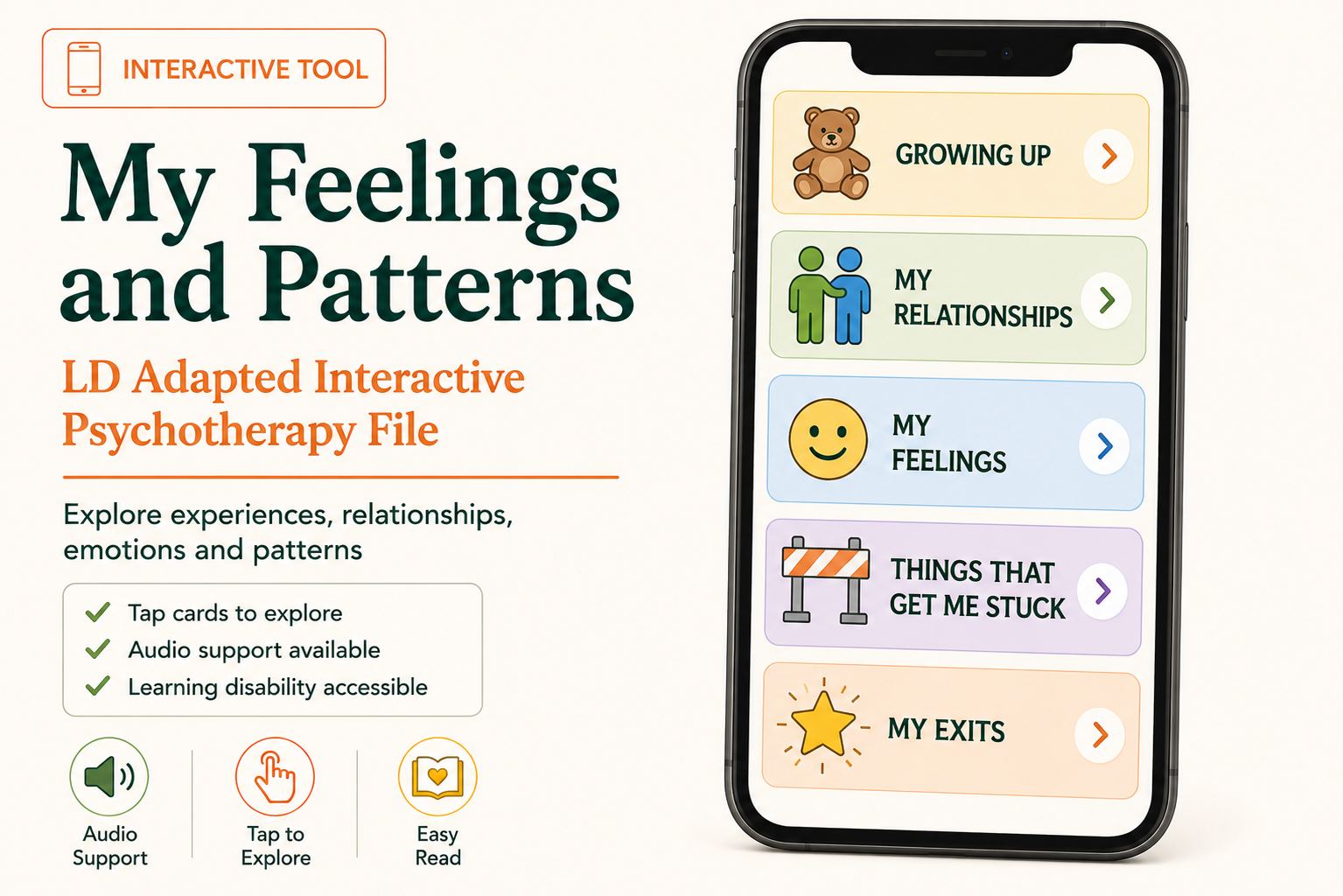
Learning Disability Interactive Psychotherapy File
Do you have a Learning Disability and want to explore your experiences and relationship patterns with your psychologist?
Or are you a psychologist working within Cognitive Analytical Therapy with Clients who have a Learning Disability?
Try try the interactive file below. It is suitable for downloading to a mobile phone.
This version was made for adults who have a mild Learning Disability. It is for people who want to understand their feelings and experiences and improve their lives. It uses a therapy called CAT. You can read more about it below.
The app uses:
Easy-to-read language
Large text
Simple choices
Emoji symbols
Clear navigation
It can help people think about experiences such as:
Other people telling them what to do
Finding it hard to speak up
Wanting more independence
Feeling worried about making mistakes
Trusting other people
Being treated unfairly
Feeling confident and having choices
You can use it on a mobile phone, tablet, or computer. You can also print the PDF version.
Interactive LD Adapted Psychotherapy File
What is Cognitive Analytic Therapy (CAT)?
Cognitive Analytic Therapy, often shortened to CAT, is a type of talking therapy.
CAT helps people understand:
How their early experiences affect them today
Patterns in relationships
Ways of thinking and feeling
Why some difficulties keep happening
CAT helps people and therapists work together to understand these patterns.
Often, a simple picture or map is used to show how different experiences connect together.
The aim is not to blame anyone. The aim is to understand what has happened and find helpful ways forward.
Important CAT Ideas
Relationship Patterns
Sometimes we learn patterns from our relationships.
For example:
Someone criticises → you feel not good enough
Someone supports you → you feel safe
CAT helps people notice these patterns.
Traps
A trap is when something you do to help yourself accidentally makes the problem bigger.
For example:
You agree to do everything so people will like you → you become overwhelmed and exhausted.
Dilemmas
A dilemma is when two choices both feel difficult.
For example:
Tell people about your difficulties and worry they may judge you
Keep it private and not get the support you need
Snags
A snag is when things start to improve, but something gets in the way.
For example:
You are offered help, but part of you feels you do not deserve it.
CAT Maps
CAT sometimes uses a simple visual map.
The map shows:
What happens
How different experiences connect together
What keeps the difficulties going
Possible ways forward
This can help people understand themselves and find new choices.
Explore more resources
Resource Library