AuDHD: Understanding Strenghts, Stress, Regulation and Growth
Understanding AuDHD: When Your Brain Needs Opposite Things
Many adults with AuDHD describe feeling as though their brain wants opposite things at the same time.
Part of you might need routine, predictability and quiet. Another part needs novelty, movement and stimulation. You might desperately want things to stay the same, while also feeling restless and craving something different.
This can feel confusing.
You might wonder why you are exhausted but can't switch off, why you're overstimulated but also bored, or why you can focus deeply one day and struggle to get started the next.
This model offers one way of making sense of these experiences. Rather than seeing them as inconsistency or personal failings, it views them as differences in how your nervous system regulates itself.
Two equally important needs
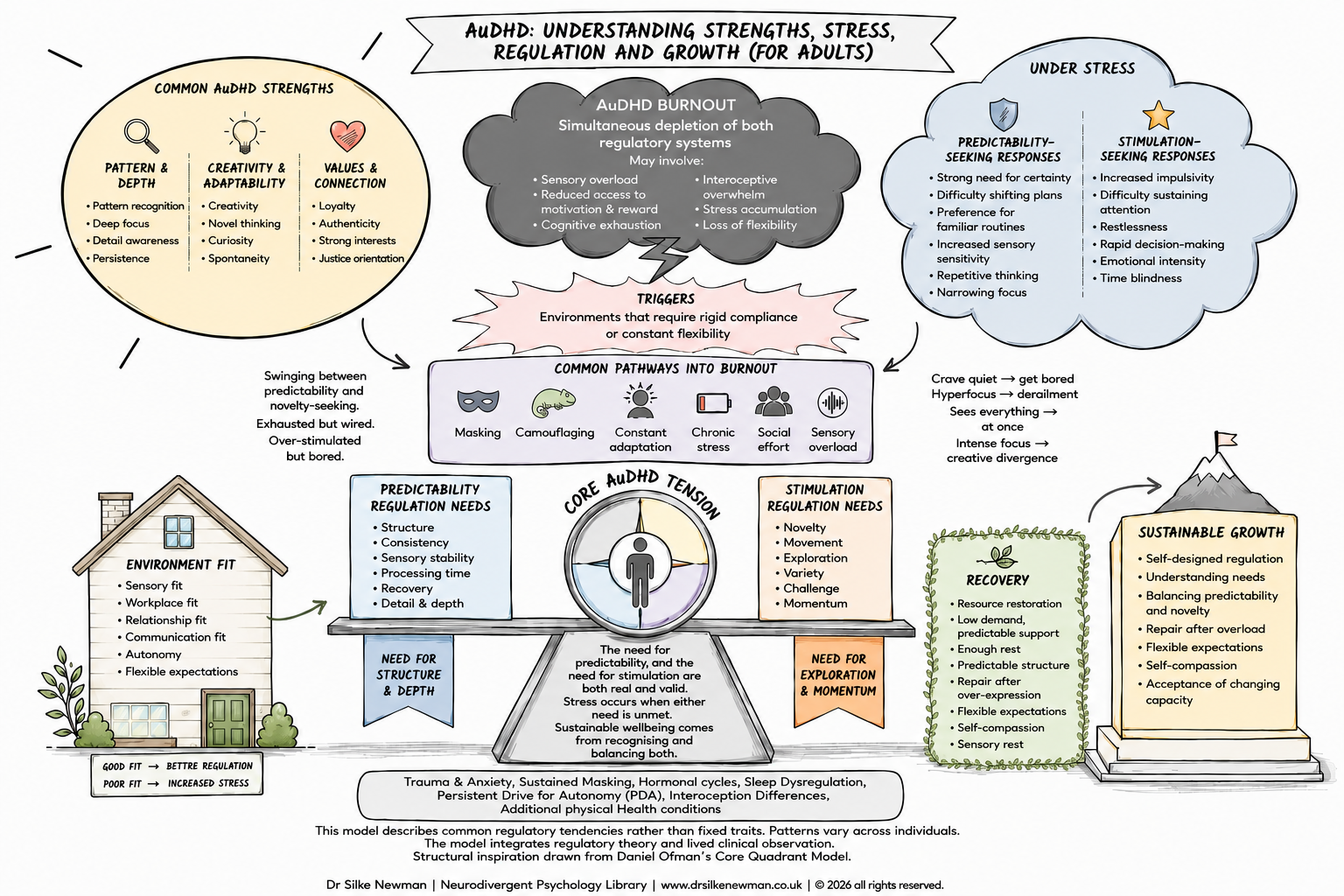
At the centre of the model is what I call the core AuDHD tension.
One part of your nervous system often needs:
predictability
structure
consistency
sensory stability
time to process
space to go into depth
At the same time, another part often needs:
novelty
movement
variety
exploration
challenge
momentum
Both sets of needs are real.
Neither is the "right" one. Neither is the problem.
The challenge comes when one or both of these needs are not being met.
Why life can feel like a constant balancing act
Many environments ask us to fit into one way of working.
Some expect us to follow strict routines. Others expect us to constantly adapt, multitask and cope with change.
For many adults with AuDHD, neither works well on its own.
You may find yourself swinging between wanting complete predictability and needing something new. You might create routines, then abandon them. Crave peace, then become bored. Hyperfocus for hours, then suddenly lose all momentum.
These patterns are often misunderstood as laziness, inconsistency or poor motivation.
This model suggests something different.
Your brain is trying to balance two equally valid regulatory systems, and those needs naturally change depending on your environment, stress levels and energy.
What happens under stress?
When life becomes stressful, both systems work even harder to protect you.
Sometimes you may find yourself seeking more certainty. You may need familiar routines, find unexpected changes difficult, become more sensitive to sensory input or feel unable to shift your thinking.
At other times, you may find yourself seeking more stimulation. You might feel restless, impulsive, struggle to sustain attention or jump quickly between ideas and activities.
These are not character flaws.
They are understandable attempts by your nervous system to regain balance.
Why burnout can feel so overwhelming
Many people with AuDHD describe burnout as feeling different from ordinary exhaustion.
Over time, things like masking, constantly adapting, social effort, sensory overload and chronic stress can wear down both regulatory systems.
Instead of one part of your nervous system becoming exhausted, both can become depleted at the same time.
Each system is working hard to help you meet different needs, and over time, the effort of constantly balancing them can become unsustainable.
When the autistic regulatory system becomes depleted, you may notice:
much greater sensory sensitivity or overload
needing more predictability and routine than usual
finding changes or uncertainty increasingly difficult
needing much longer to process information
withdrawing socially or becoming quieter
feeling emotionally and physically overwhelmed
reduced tolerance for demands, noise or social interaction
losing the energy to mask or camouflage
increased shutdown or freeze responses
The nervous system has less capacity to create safety and reduce overwhelm.
When the ADHD regulatory system becomes depleted, you may notice:
difficulty starting even enjoyable tasks
losing access to motivation and interest
reduced reward from activities that usually feel engaging
struggling to sustain attention or organise thoughts
brain fog and mental fatigue
feeling stuck rather than restless
reduced spontaneity and creativity
losing momentum more quickly
finding decisions increasingly difficult
The nervous system has less capacity to generate activation, interest and energy.
When both systems become depleted together
For people with AuDHD, these two patterns can happen at the same time.
You may desperately need quiet but feel restless.
You may want stimulation but have no energy to seek it.
You may crave routine but lack the executive functioning to create it.
You may know exactly what needs doing but feel unable to begin.
You may feel emotionally overwhelmed while also emotionally numb.
This is why AuDHD burnout can feel so confusing. Your brain is asking for opposite things while having reduced capacity to meet either need.
This can leave you feeling physically and mentally exhausted, emotionally overwhelmed, unable to think clearly and struggling to do things that once felt manageable.
Your strengths matter
The same neurotypes that can make life challenging also bring many strengths.
Many adults with AuDHD describe strengths such as:
noticing patterns others miss
deep focus
creativity
curiosity
authenticity
loyalty
strong values
a strong sense of fairness
These strengths are not separate from your AuDHD. They come from the same way your brain experiences and understands the world.
What helps?
The goal is not to change who you are.
The goal is to understand how your nervous system works so you can support it.
For many people, this means:
balancing structure with flexibility
balancing predictability with novelty
allowing proper recovery after periods of stress
creating environments that fit your needs
practising self-compassion rather than self-criticism
accepting that your energy and capacity naturally change from day to day
Recovery is not a reward for being productive.
It is part of staying regulated.
A different way of understanding yourself
This model does not suggest that every person with AuDHD experiences these patterns in the same way. Everyone is different.
Instead, it offers a different way of understanding experiences that are often labelled as inconsistency, laziness or "not trying hard enough."
Perhaps you are not failing.
Perhaps your nervous system is working incredibly hard to balance two different, equally important needs.
When we understand that, shame often begins to give way to curiosity, self-understanding and more compassionate ways of living, helping us to re-calibrate what works for us and what is typical for our own unique nervous system, rather than trying to fit someone else's idea of "normal."
Regulating: Your Internal Conductor
One way to think about AuDHD is to imagine that your brain has an internal conductor .
This isn't a separate part of the brain or a medical term. It is simply a way of understanding how your nervous system is constantly trying to balance different needs.
Imagine an orchestra. The role of the internal conductor is to listen to all instruments and decide what is needed in that moment.
One section is asking for predictability. It wants routine, familiarity, sensory safety, time to think and opportunities to go deeply into things.
Another section is asking for stimulation. It wants novelty, movement, curiosity, variety, challenge and momentum.
Neither section is wrong.
Neither is trying to work against the other.
Both are trying to help you feel regulated and able to engage with the world.
The role of the internal conductor is to listen to both and decide what is needed in that moment.
Sometimes it might say:
"You've had a busy week. Let's choose a quiet evening and give your nervous system time to recover."
At other times it might say:
"You've been doing the same thing for days. Let's introduce something new or take a different approach."
The conductor is constantly gathering information from your body, your mind and your environment. It notices your energy, stress levels, sensory load, motivation, emotions and capacity, then tries to find the best balance between safety and stimulation.
When life is relatively balanced, this process often happens automatically. This can me more challenging when masking, sensory overload, social demands, uncertainty, fatigue and the effort of managing daily life play extra demands on this balancing system.
Over time, your internal conductor may have less capacity to coordinate effectively.
Learning to listen to your conductor
Many of us have spent years trying to ignore our nervous system in order to meet other people's expectations.
This model invites something different.
Rather than asking, "What's wrong with me?" it encourages us to ask:
What is my nervous system telling me right now?
Do I need more predictability or more stimulation?
Am I running on empty?
What would help me feel more regulated today?
If you want to explore your neurotype using the template of tAuhe model, you can download it here.
Explore more resources