Interactive and PDF ND Adapted Psychotherapy File
Neuro-affirmative Cognitive Analytical Therapy (CAT) informed Tools
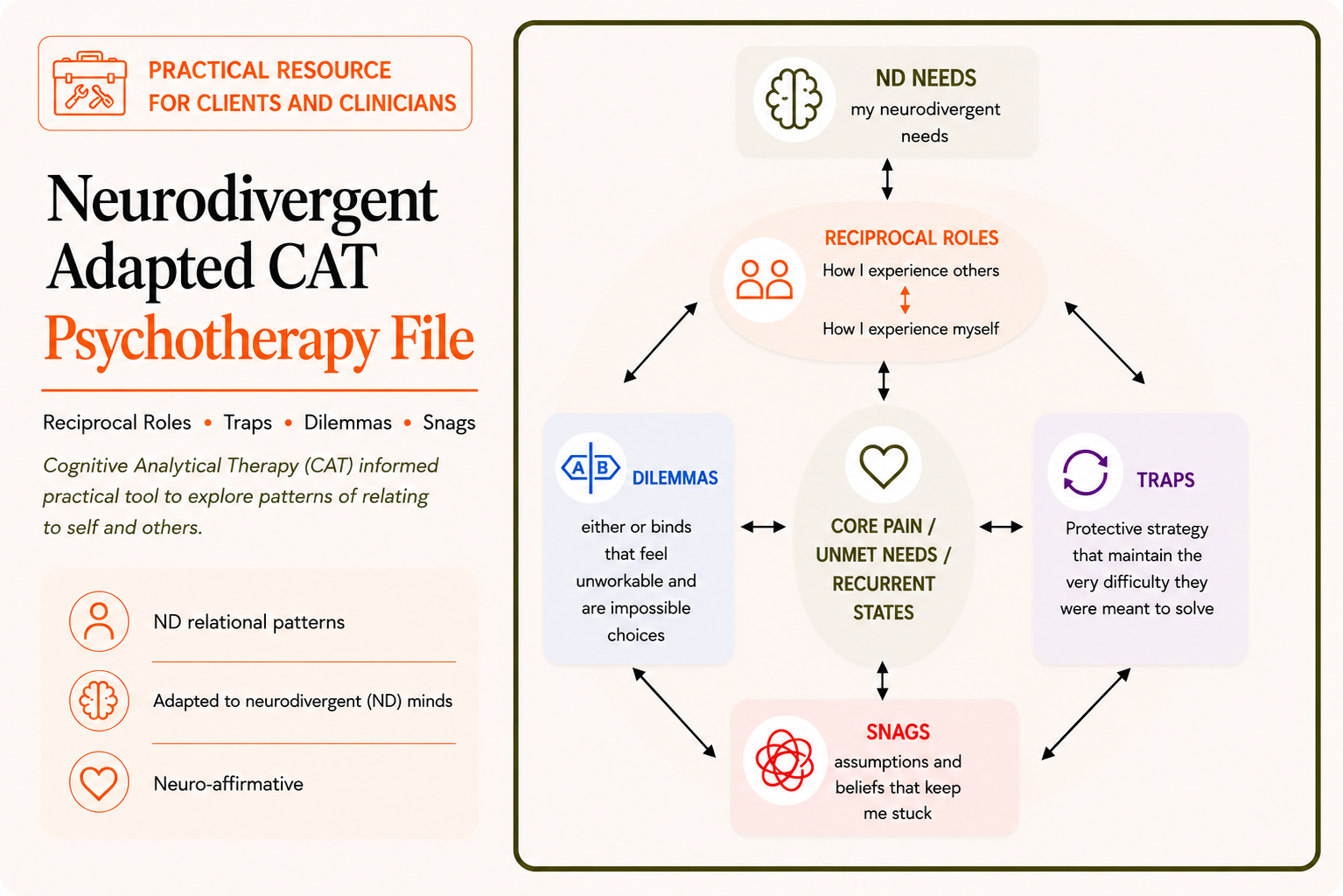
Cognitive Analytic Therapy reflection tools — specifically adapted to neurodivergent minds.
Cognitive Analytic Therapy (CAT) offers a structured way to map patterns of how you relate to yourself and others. CAT can be helpful in understanding yourself, where patterns of relating come from and to begin to see yourself differently. They can be used with a therapist or to support client reflection. Typically, in CAT, the “Psychotherapy File” is used during the assessment and formulation stage. The Psychotherapy file has been adapted to neurodivergent minds and experiences. It can be shared with your therapist.
The Cat Psychotherapy file is not diagnostic instrument. They are a starting point for conversation — a way for us to begin locating our own experience, and for clinicians to build a richer, more accurate formulation (understanding of how problems are maintained). I find them useful when working on generating a shared understanding with clients using a Reformulation (visual CAT map) to illustrate how difficulties and experiences may be maintained.
ND (Neurodivergent) Adapted Psychotherapy File (Questionnaire)
This tool draws on neurodivergent literature, adaptations derived from clinical experience and neurodivergent feedback. The tool has not yet been formally evaluated. Whilst I have completed CAT training courses as part of my professional development, I am not formally trained or accredited as a CAT practitioner or CAT therapist. The tool is tailored to the specific relational patterns, emotional states, and formulation priorities of neurodivergent minds. The tool is useful for self-exploration before and alongside therapy. Based on Ryle et al. You can download the PDF below. There is a separate Learning Disability adapted Psychotherapy file. There is further information below to reflect on why the adaptations were considered necessary.
Interactive ND Adapted Psychotherapy File
Reflection Tools for neurodivergent minds
Rejection sensitivity · Over-promising · Shame cycles · Burnout · Late diagnosis grief
Developed for adults with ADHD, Autism, or both attending therapy — or preparing to. The client file maps CAT pattern cards across 4 domains, from early learnt relationship patterns (Traps), Dilemmas, Snags and recurrent states with exit strategies. Central themes include:
Rejection sensitivity · Over-promising · Shame · Burnout · Late diagnosis grief, Masking · the Double empathy problem · Monotropism · Identity after late diagnosis
Neurodivergent Adapted CAT question Bank
For clinicians working with autistic adults, adults with ADHD, and AuDHD presentations
The Neurodivergent Adapted CAT Question Bank is a clinician reference tool designed to support Cognitive Analytic Therapy-informed assessment and formulation work with neurodivergent adults.
Standard CAT questions were developed with neurotypical presentations in mind. This bank adapts that framework to account for the specific ways that ADHD, autism, and AuDHD shape early experience, relational patterns, self-perception, emotional regulation, and the therapeutic relationship itself.
What is Cognitive Analytic Therapy?
Cognitive Analytic Therapy (CAT) was developed by Anthony Ryle in the 1990s as an integrative, time-limited psychotherapy that draws on both cognitive and psychoanalytic traditions. It centres on the idea that our emotional and relational difficulties arise from procedural patterns — learned ways of thinking, feeling, and relating that developed in response to our early experiences.
CAT uses collaborative tools — including the Sequential Diagrammatic Reformulation (SDR) — to map these patterns, name them clearly, and create a shared language for change. It is relational, explicitly non-pathologising, and oriented toward understanding rather than symptom management.
These tools adapt CAT's core concepts for neurodivergent presentations, holding both neurological difference and the genuine emotional impact of living in environments that were not built for neurodivergent brains.
Reciprocal Roles
The relational patterns we learned — what one person does, and what tends to happen in response. Mapped as pairs: e.g. disappointing ↔ disappointed.
Traps
Self-reinforcing cycles where the coping strategy maintains the very difficulty it was meant to solve — e.g. over-promising to avoid rejection, which leads to more rejection.
Dilemmas
Either/or binds where both options feel unworkable — e.g. either disclose and risk judgment, or stay hidden and remain unsupported.
Snags
Patterns that derail progress just as change becomes possible — often rooted in a belief that good things are not available to this person.
Reformulation Diagram
CAT uses a visual map to show how difficulties are maintained to help create exit strategies.
Why adapt the original Psychotherapy File?
The Psychotherapy File is a well-established tool from Cognitive Analytic Therapy (CAT), used in clinical practice for several decades. It is designed to help people recognise the recurring relational and procedural patterns — the traps, dilemmas and snags — that can keep them feeling stuck.
CAT is, at its heart, a relational model. It understands our patterns as developing within relationships — learned early, in response to how we were treated — rather than as flaws within the individual. This is one of its real strengths. The standard file, however, was developed with neurotypical development in mind, and that creates genuine limitations when it is used with autistic, ADHD and AuDHD adults.
Two difficulties tend to arise. First, some neurodivergent ways of being — a need for routine, withdrawing to recover, intense focus, directness of communication — can be read as traps or relational difficulties, when they are better understood as differences. Second, the file locates the origins of difficulty in early relational experience. For neurodivergent people, this can leave two things out: neurology itself, and the ongoing mismatch between a neurodivergent person and a world built around neurotypical brains. The patterns are not only shaped by past relationships; they are sustained, in the present, by environments that do not fit.
Much of what can look like a "trap" — exhaustion, avoidance, people-pleasing, withdrawal, all-or-nothing effort, shame — is rarely a flaw in character, and rarely something that lives in a person alone. More often it is a learned, protective response to years spent in environments that were never designed for the way a person's mind works — and to the daily demands of a world that still isn't. The difficulty lies less within the individual than in the fit between person and environment.
This is why I adapted the file — as a clinician, and as someone who is neurodivergent myself. The aim was to keep everything that makes the Psychotherapy File valuable, while changing what it quietly assumes, so that the people using it are met as they actually are.
The adapted version differs from the original in several ways:
Its language is neuroaffirmative throughout — grounded in difference rather than deficit. Difficulty is named honestly, but never treated as a fault in who someone is.
It incorporates patterns the original does not address, including rejection sensitivity, autistic inertia, masking, burnout, monotropism, the double empathy problem, and the cumulative impact of repeated invalidation and trauma.
Patterns are framed as understandable responses to real experience — often strategies that once helped a person cope or survive, and that now carry a cost.
Strengths are integral to the picture.
The exits point outward as well as inward: for neurodivergent people, the way forward often involves reshaping the environment and putting adaptations in place, rather than changing the self or interactions alone.
It is designed for accessibility — plain language, read-aloud and dictation options, and a one-step-at-a-time structure.
Above all, it is a tool for noticing and naming: a gentle starting point for therapy and reflection, and a companion to that work rather than a substitute for it.
Explore more resources