Getting an ADHD Assessment in the UK: Understanding Your Options
Are you considering a private ADHD assessment?
Understanding whether you have ADHD can be a significant step in your journey of self-discovery and self-acceptance. However, it can be a struggle to decide how to obtain an assessment and diagnosis.
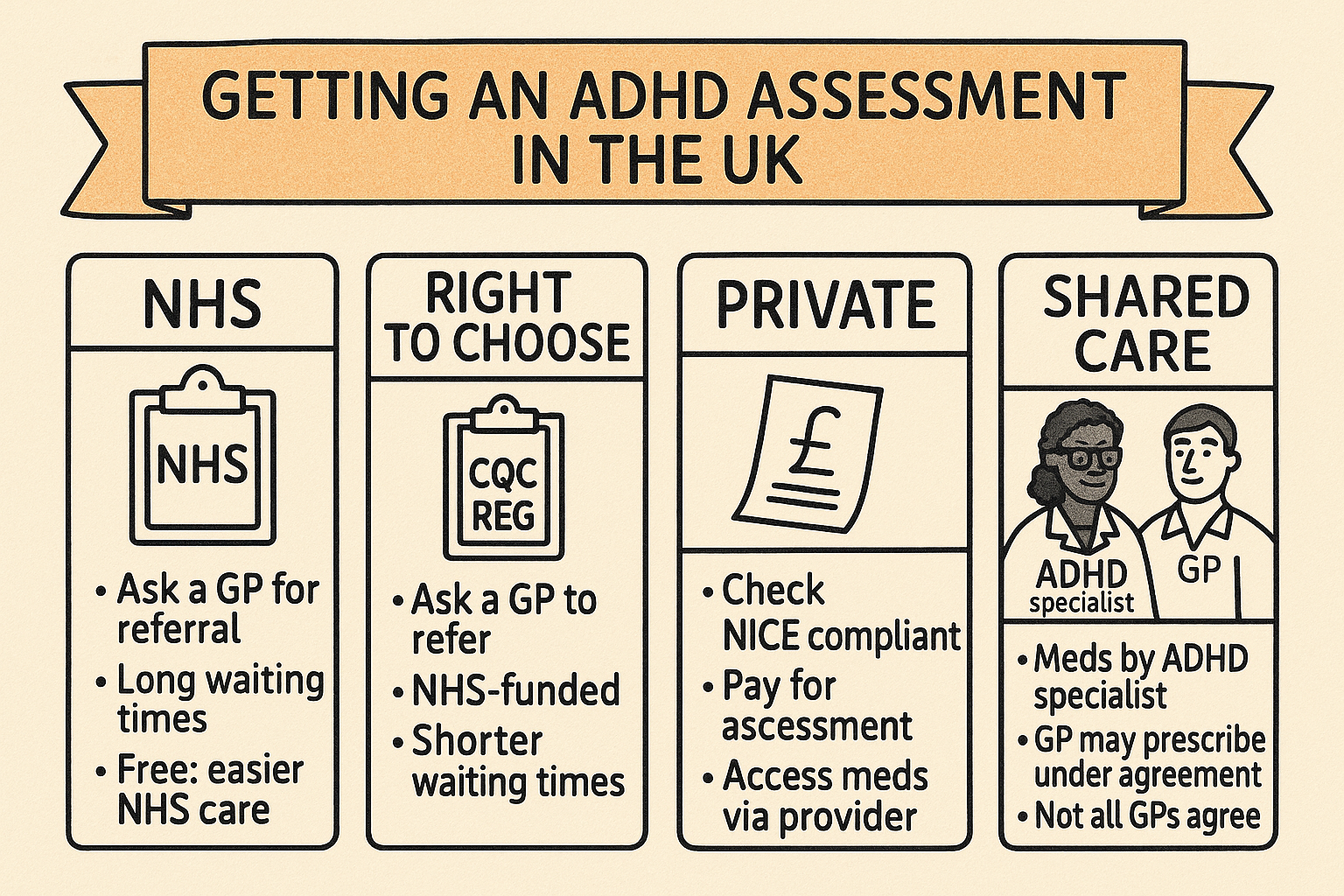
There are four main ways to get an ADHD assessment in the UK. Each has different waiting times, costs, and levels of flexibility. Below is a more detailed guide to help you understand what each pathway means and what to expect from the process.
1. NHS Referral (via Your GP)
Overview:
This is the standard route. You ask your GP for a referral to the local NHS ADHD service (adult or child, depending on your age).
Cost:
Free at the point of use (covered by the NHS).
Choice of Clinician:
You usually cannot choose your specific clinician or clinic — it depends on local NHS services.
Some areas have specialist ADHD teams; others may refer to general mental health services or neighbouring trusts.
Waiting Time:
Often very long — from several months to 2–3 years in some areas.
Medication and Titration:
If you’re diagnosed, the psychiatrist or ADHD nurse specialist can prescribe medication.
You’ll go through a process called titration, which means adjusting your dose gradually to find the best balance between benefits and side effects.
Titration usually takes 8–12 weeks, but sometimes longer depending on your response.
Once stable, your GP will continue prescriptions under a shared care agreement (where the specialist and GP share responsibility).
Returning to NHS Care:
You’re already within the NHS, so there’s no need to “return” — your care continues seamlessly you’re already inside the NHS care system.
2. Right to Choose (NHS-Funded Private Provider)
Overview:
Under the NHS Right to Choose scheme, you can ask your GP to refer you to a CQC-registered private provider that holds an NHS contract.
These providers deliver the assessment on behalf of the NHS, often through online appointments.
Cost:
Free for you — it’s paid for by the NHS.
Choice of Clinician:
You can choose the provider (e.g., Psychiatry-UK, Clinical Partners, ADHD 360, etc.) but not always the individual clinician.
All clinicians are qualified NHS psychiatrists or nurse prescribers.
Waiting Time:
Usually much shorter than local NHS lists — often a few months instead of years.
Medication and Titration:
Managed by the provider’s ADHD team.
Titration is similar to NHS care — a step-by-step process of adjusting dose and medication type, with regular online check-ins and blood pressure monitoring.
After titration, your GP is usually asked to take over prescribing through a shared care agreement.
Because this route is NHS-funded, shared care is almost always accepted.
Returning to NHS Care:
You remain within the NHS system, so ongoing care or reviews can transfer smoothly to your GP.
3. Private (Self-Funded) Assessment
Overview:
You book and pay privately for an ADHD assessment with a qualified psychiatrist , Psychologist, or multi-disciplinary team.
Cost:
Typically £600–£1,300 for an adult assessment.
If you have private insurance, such as Bupa, depending on your health plan, they may cover the cost of a a diagnostic assessment and medical treatment. You will have to choose one of their listed private providers.
Some clinics offer packages including titration and follow-up (these can range from £1,000–£1,800 total).
Medication itself is an additional cost (private prescriptions are not NHS-subsidised).
Choice of Clinician:
You can choose your clinic, preferred clinician, and appointment timing.
Always ensure the clinician is qualified appropriately: In the UK, ADHD assessments must be conducted by qualified specialists according to NICE guideline 87.
Specialist Psychiatrists are GMC-registered, Clinical Psychologists are HCP-registered, Specialist ADHD nurses are NMC-registered Check the assessment is comprehensive and follows NICE guidelines.
Other Therapists (e.g., psychologists, counsellors, coaches) cannot act as single assessor. Please note that the UK the term psychologist itself is not a protected title. All Clinical psychologists need to be registered with the HCPC (Health and Care Professionals Council).
Medication and Titration:
Private psychiatrists and ADHD nurses (independent prescribers )can prescribe ADHD medication (e.g., methylphenidate, lisdexamfetamine, atomoxetine). Clinical Psychologist cannot prescribe.
Titration means slowly adjusting the dose to find the most effective and comfortable level — usually over 6–12 weeks, though it can take longer.
You’ll have regular check-ins (online or in person) and must record pulse, blood pressure, and weight.
Returning to NHS Care:
Once you’re stable, you can ask your private psychiatrist to contact your GP to request a shared care agreement.
Some GPs agree if the psychiatrist is properly registered and uses NICE-compliant medication protocols.
Others decline, meaning you may need to continue private prescriptions until you can transfer to an NHS ADHD team.
If you want NHS follow-up later, the NHS may accept your report or may request a review first.
4. Shared Care (Ongoing Medication Agreement)
Overview:
Once your diagnosis is complete and your medication is stable, your care can be shared between your specialist and GP.
Cost:
NHS prescriptions are charged at the standard NHS rate (around £9.90 per item in England).
Your GP appointments remain free.
Process:
The ADHD specialist manages diagnosis and titration.
When your dose is stable, they send a shared care protocol and letter to your GP.
The GP agrees to take over prescribing and physical health checks (e.g., blood pressure, pulse, weight).
The specialist remains available for review if your symptoms or medication change.
Length and Monitoring:
After transferring to shared care, you’ll usually have annual reviews (or more frequent if needed).
You’ll still need to attend occasional check-ins to renew prescriptions safely.
If Shared Care Isn’t Accepted:
You can stay with your private or NHS specialist for medication management, though this is more expensive privately.
You can also request referral to an NHS ADHD service for review and transfer.
In Short
Titration is a gradual medication adjustment process — it’s essential for safety and finding the best fit.
Right to Choose is often the quickest NHS-funded option with minimal cost.
Private assessments offer control and speed, but transferring care back to the NHS depends on your GP’s willingness.
Shared care keeps your treatment safe, sustainable, and integrated long-term.
Understanding the Assessment process
A thorough private assessment typically takes several hours and involves various components:
- Clear explanation of costs and if the person is a recognised provider for insurance
- Use of comprehensive tools for ADHD (DIVA or ACE) and related conditions
- Collecting comprehensive information about your development via forms and/or interview
- Information from parents, family members or others who know the person well (with their consent) about their development and upbringing
Feedback and a detailed report that you can review, check for accuracy and discuss in detail with the clinician
Differential Diagnosis
The assessor should be able to carefully consider other factors that may explain your experiences such as mental health conditions (PTSD/trauma, Bipolar disorder and Borderline Personality Disorder) and other neurodevelopmental conditions (for example, Autism). This is because there can be a large amount of overlap between ADHD and other conditions.